MCD-900-1 · The original Vision counterfeit detector
Never beaten by a single note.
We guarantee it.
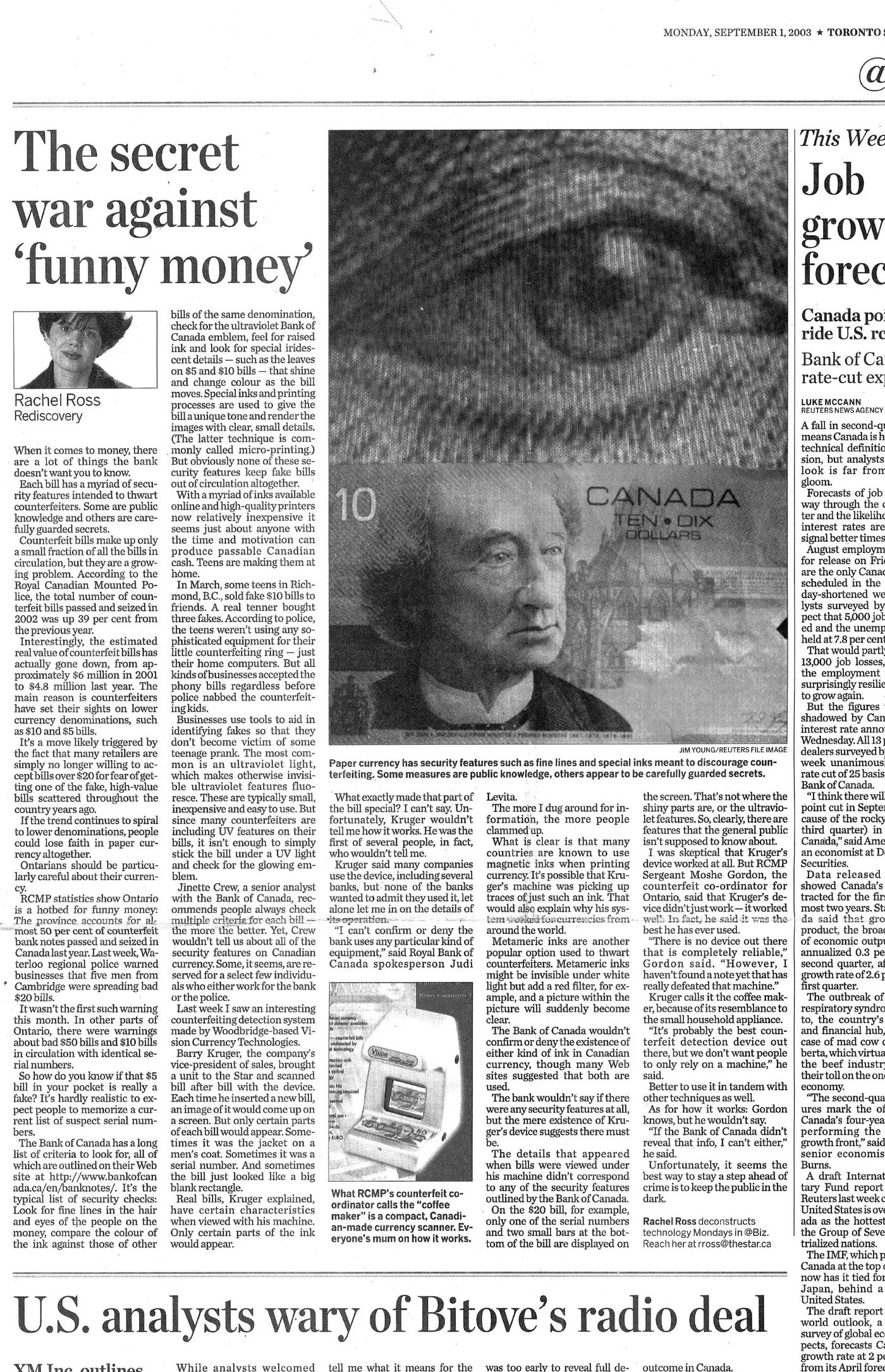
“There is no device out there that is completely reliable. However, I haven’t found a note yet that has really defeated that machine.”
Sgt. Moshe Gordon, RCMP counterfeit co-ordinator for Ontario · Toronto Star, September 2003
Secure checkout by Stripe. You complete your purchase on Stripe’s own encrypted page. Tellervision never sees, handles or stores your card number.
VisaMastercardAmexApple PayGoogle Pay
Your delivery address is collected at checkout. Ordering means you accept our Terms & Conditions, which cover delivery, returns, refunds and warranty.
Buying for more than one location, or need an invoice or purchase order instead of paying by card? That is handled person to person, not through the cart.
Barry Kruger owned and operated a bar and restaurant in Ontario when counterfeit currency came across his own counter. At the time, spotting a fake meant touch, feel and a visual check, and he found it near impossible to train staff to do that reliably during a rush.
He went looking for equipment instead. In 1999 he brought the Vision detector to Canada — the first detector of its kind on the market here — and worked with local police and corporate security teams to show what the technology could do. Today Tellervision is the manufacturer, owner and distributor of the Vision detector — for North America and worldwide.
Twenty five years later the job has not changed. A cashier has a few seconds, a line behind them, and no interest in becoming a forensics expert. The machine has to give a clear answer in that window.
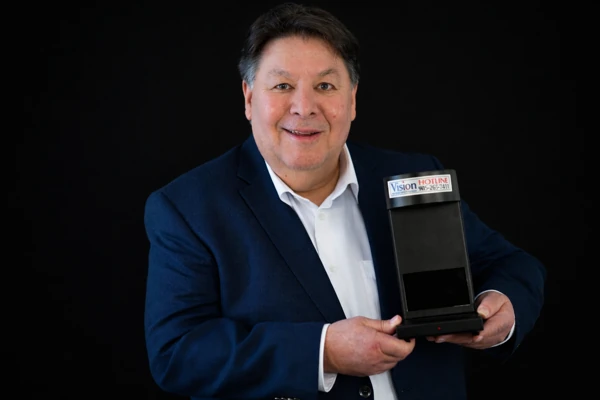
Barry KrugerFounder, Tellervision Business Solutions Inc.
In business since
1999
Role
Manufacturer, owner & distributor
Support
24 hours, 7 days
The detector
Vision MCD-900-1
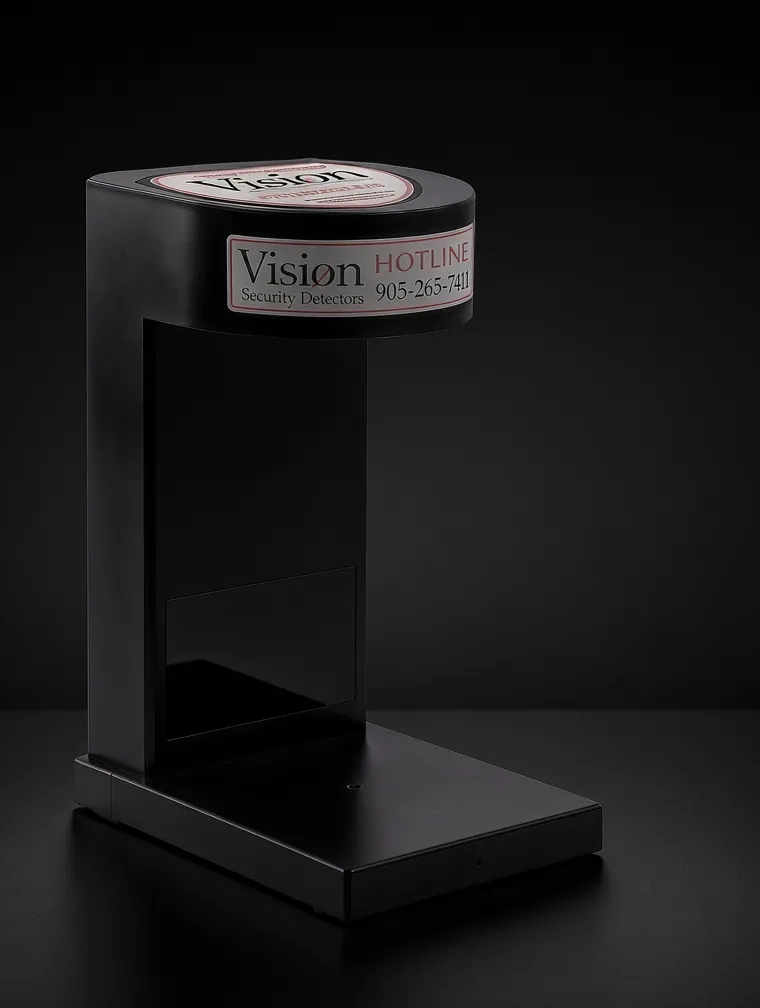
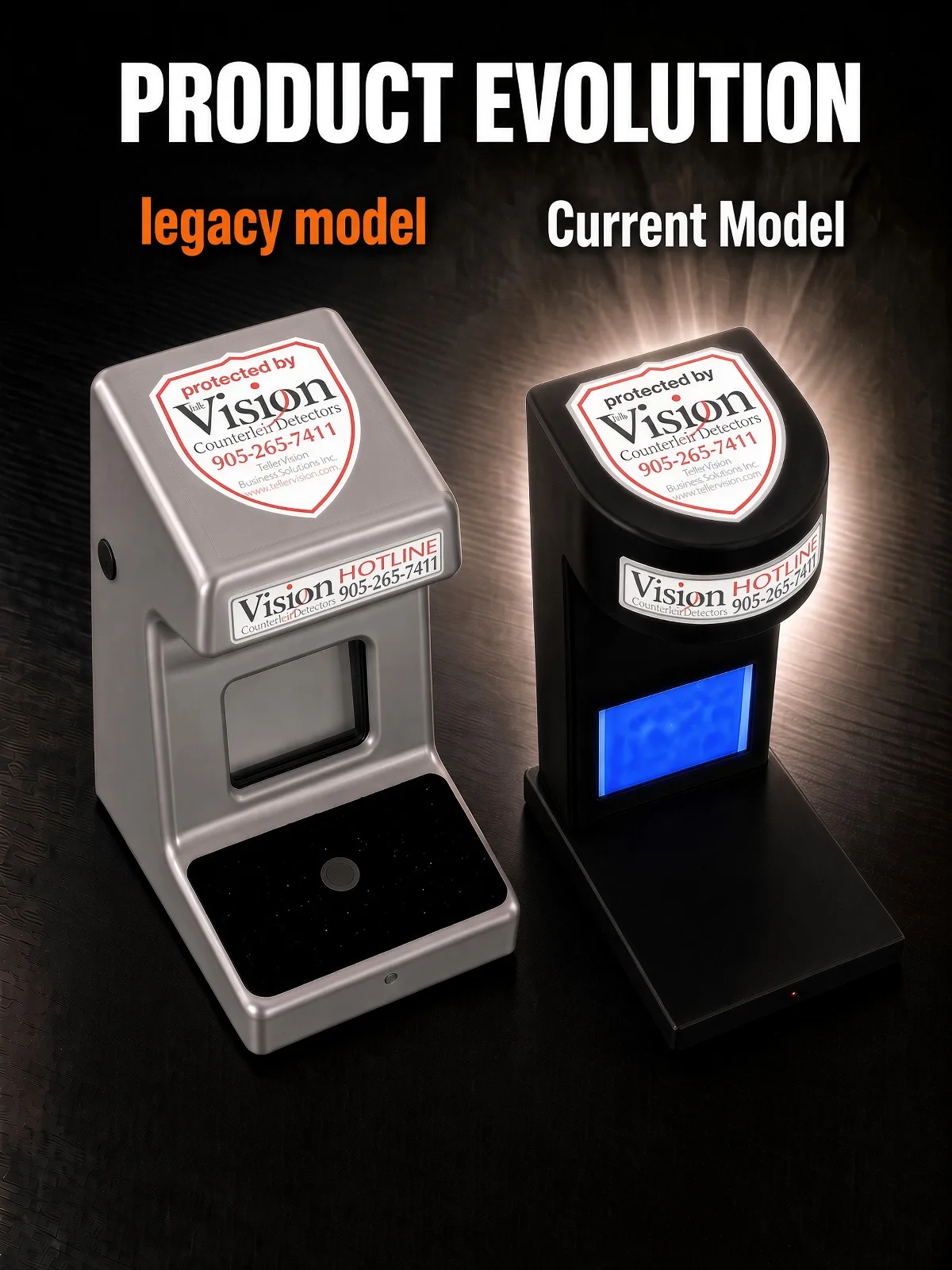
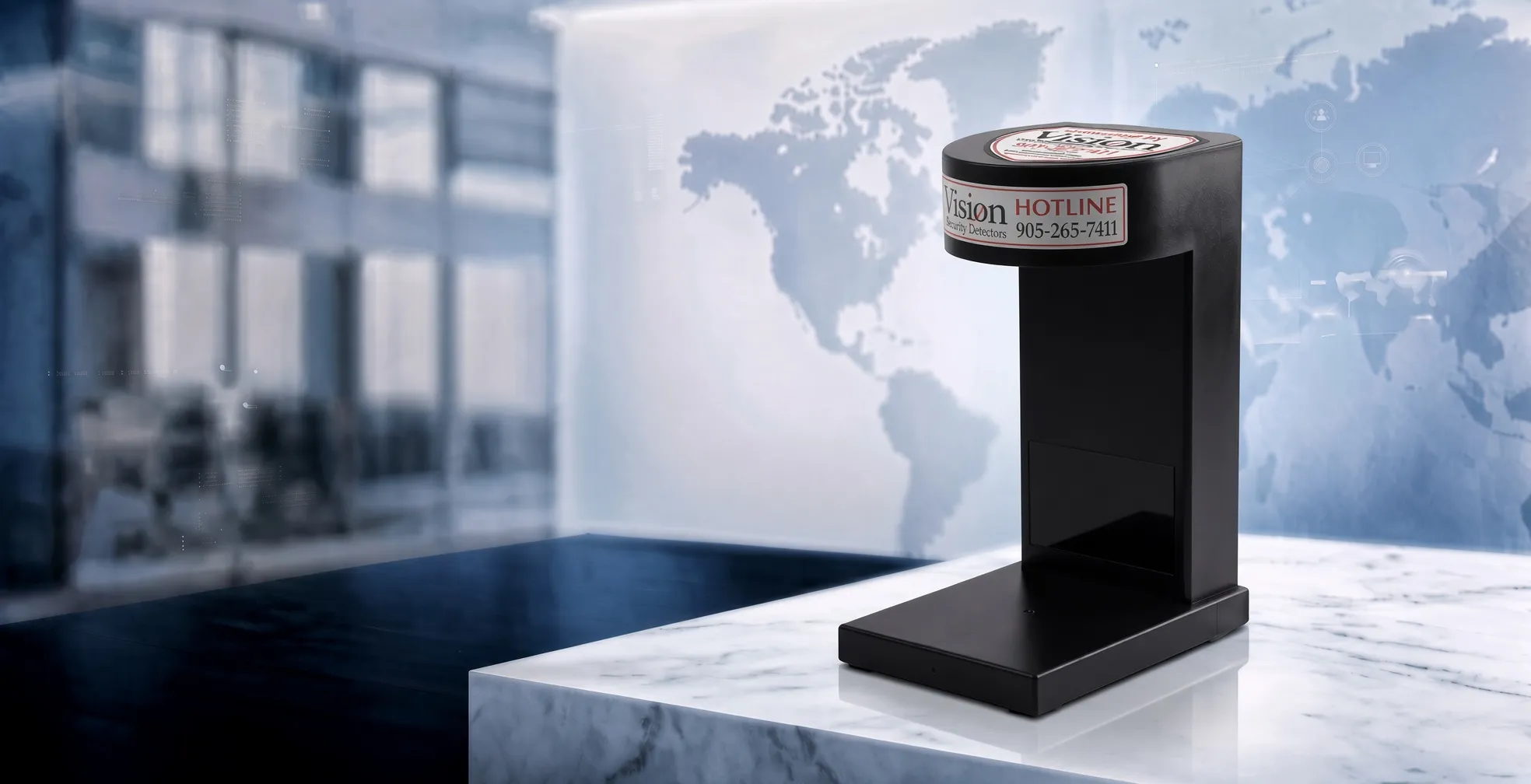
An infrared counterfeit money detector built for the checkout counter. Launched in 1999 and redesigned in 2015 at the request of corporate customers who wanted the same performance in less counter space. The core detection technology did not change.
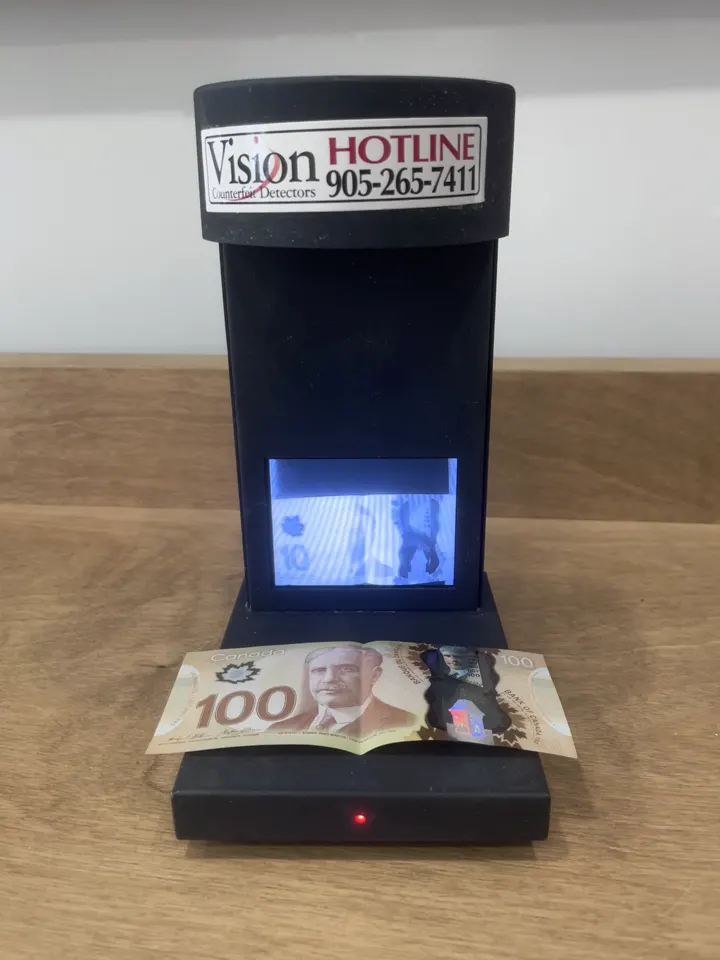
1999 The original grey detector. Its plastic casing scratched and tarnished with years on the counter. 2015 Barry’s redesign: a dark steel cabinet that always looks new, a flat screen in place of the old monitor, and a smaller footprint beside the register. The detection technology inside is unchanged.In action A genuine $100 under the lens — the infrared result appears on screen the moment the note slides in. No buttons, no training, no judgment call.
01
Infrared detection
Reads the infrared security features printed into the note rather than asking a person to judge feel and colour.
02
4.3 inch LCD monitor
The result appears on a screen at eye level, so a cashier is not leaning over a viewing window in front of a customer.
03
Auto on and off sensor
Wakes when a bill goes in. Nothing to switch, nothing left running through a shift change.
04
Steel cabinet
Engineered so it will not scratch or tarnish on a counter. Built for the front line, not a back office.
Technical specifications
Detection technology
Infrared (IR)
Monitor
4.3 inch LCD
Power supply
110–220 V, 50–60 Hz
Power consumption
< 8.5 W
Operating temperature
0 to 50 °C (32 to 122 °F)
Humidity
20% to 70%
Dimensions
230 × 130 × 160 mm (9.06 × 5.5 × 6.3 in)
Weight
2.1 kg (4.6 lb)
No updates when the money changes
When new banknotes are released you do not have to update, subscribe or replace anything. The detection method reads the note itself, so there is no recurring cost and no maintenance schedule.
How it’s made
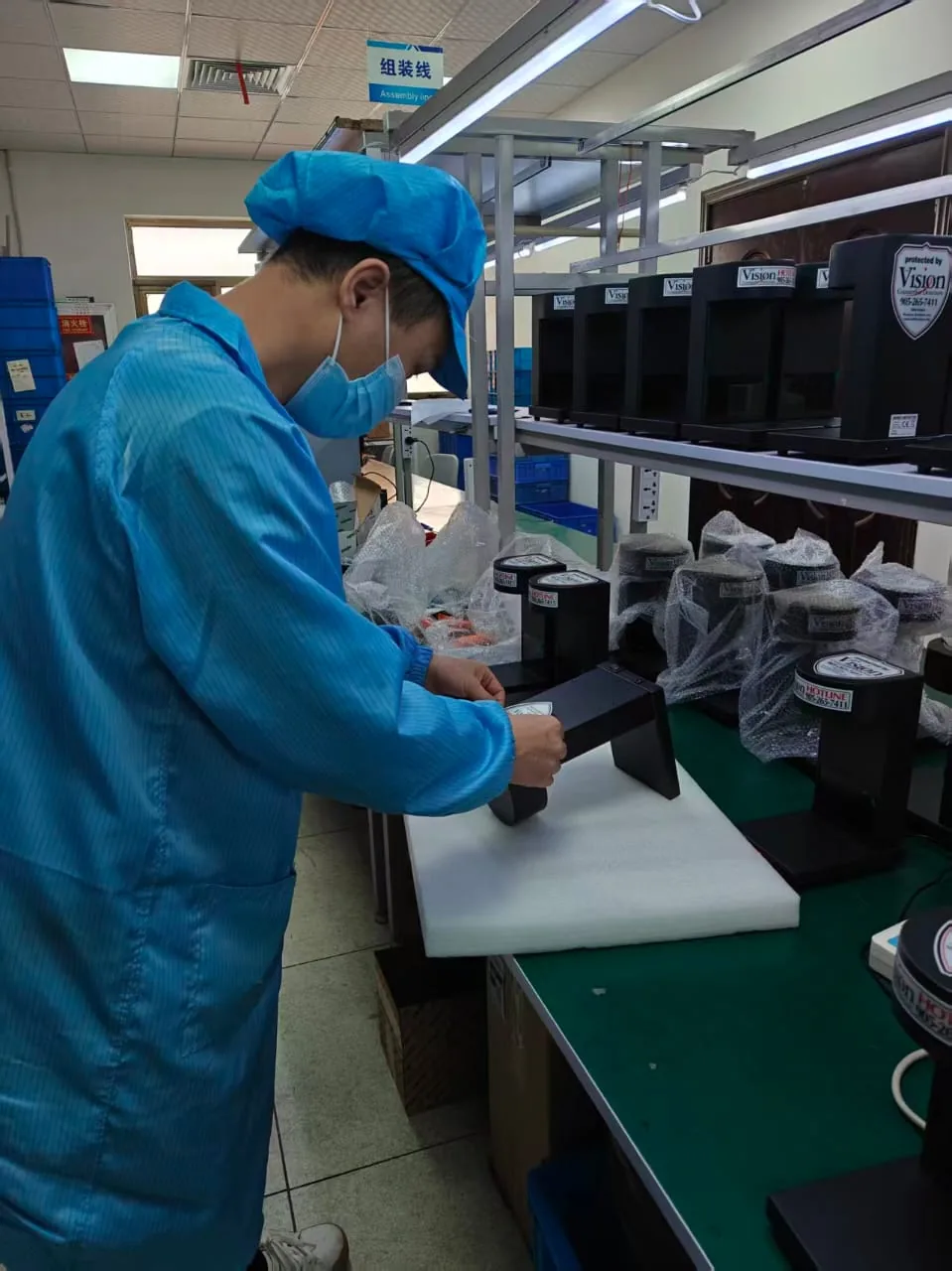
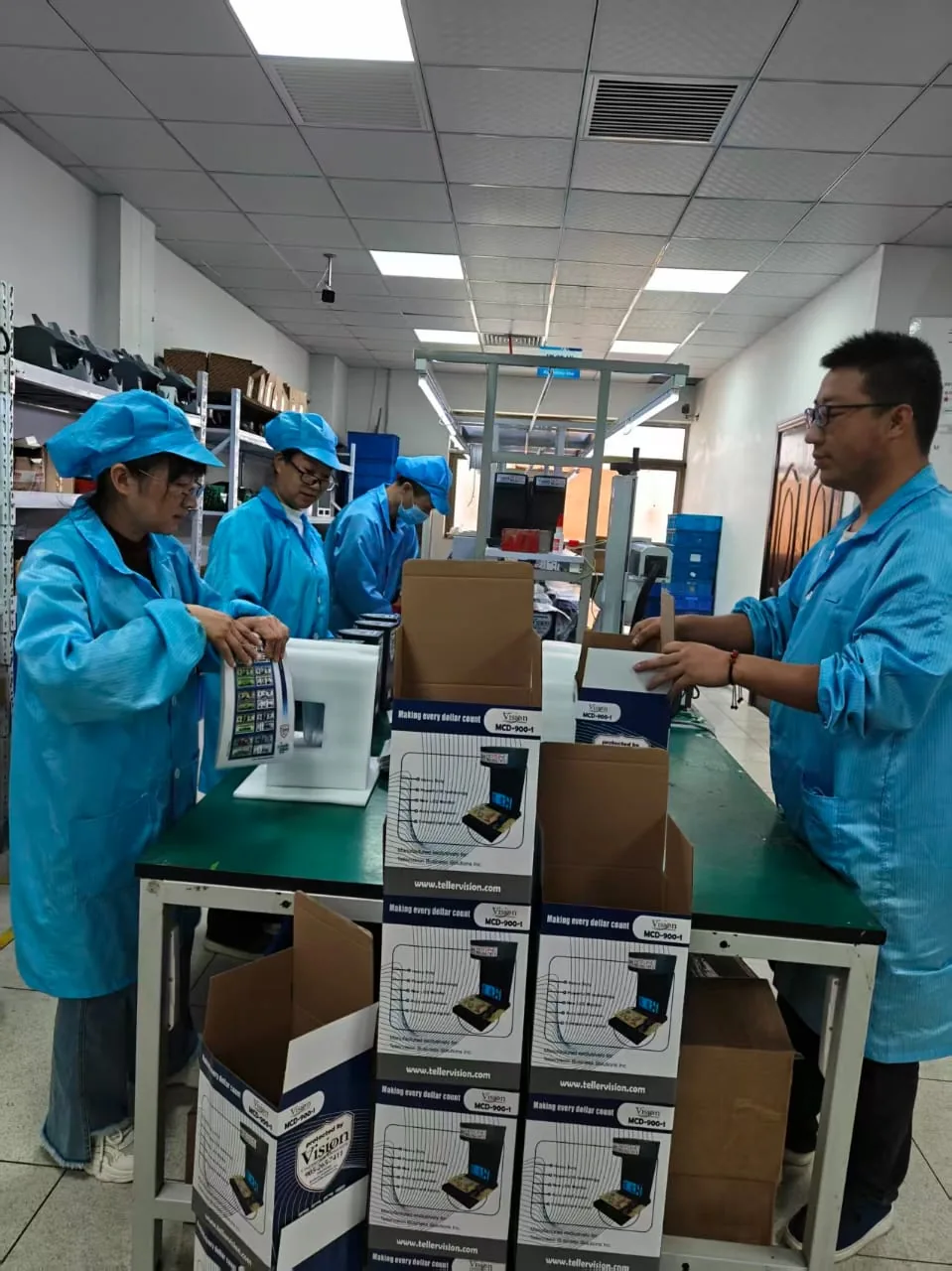
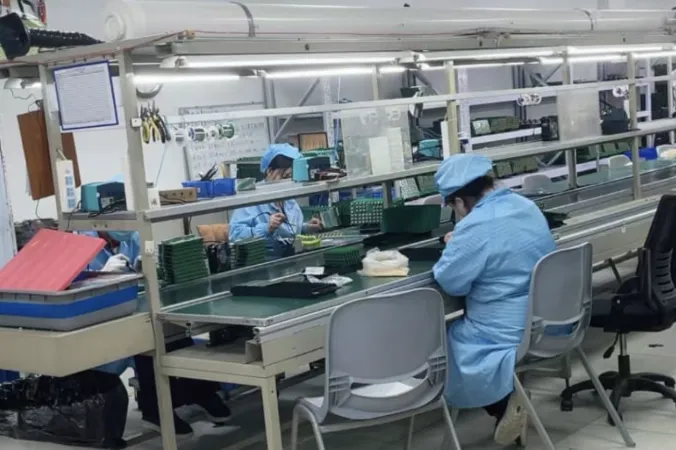
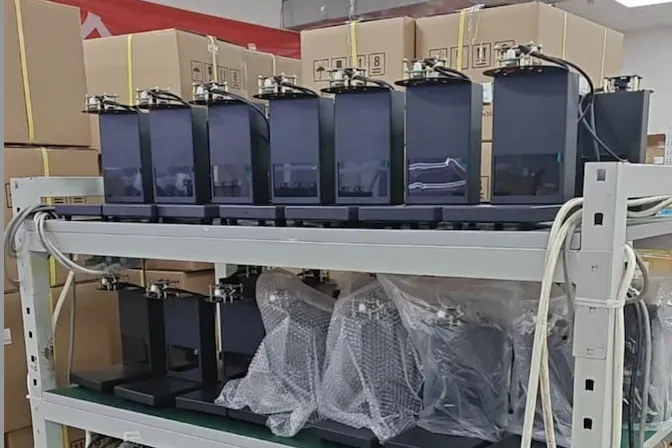
Built on a dedicated line, and checked by hand.
These photos are from our own factory in China, where the Vision MCD-900-1 is built on a dedicated assembly line — each unit assembled, labelled and quality-checked by hand before it ships in Tellervision packaging. Tellervision has manufactured, owned and distributed the detector since 1999, for North America and worldwide.
Making every dollar count. Every unit is assembled, fitted with the hotline decal, and checked before it leaves the line.
See it work
What your staff actually sees.
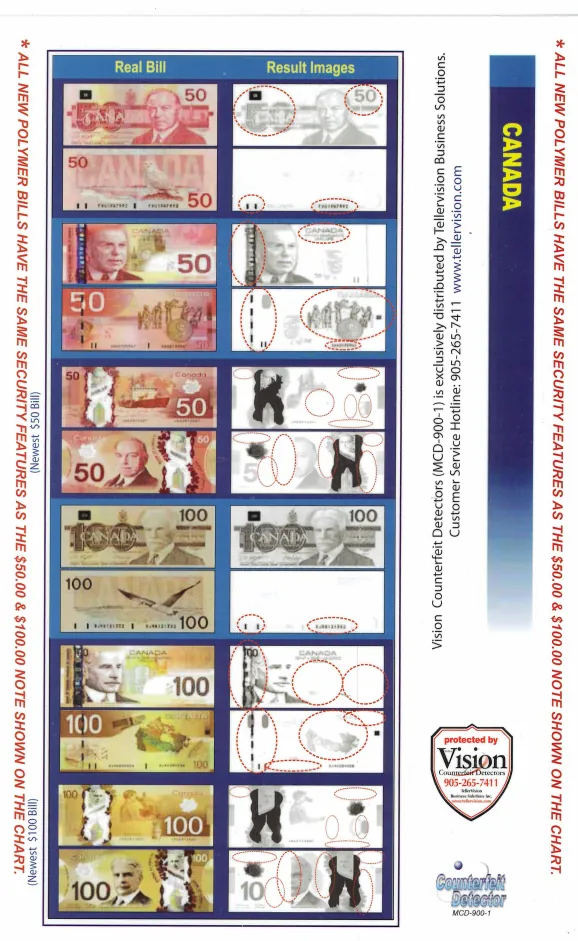
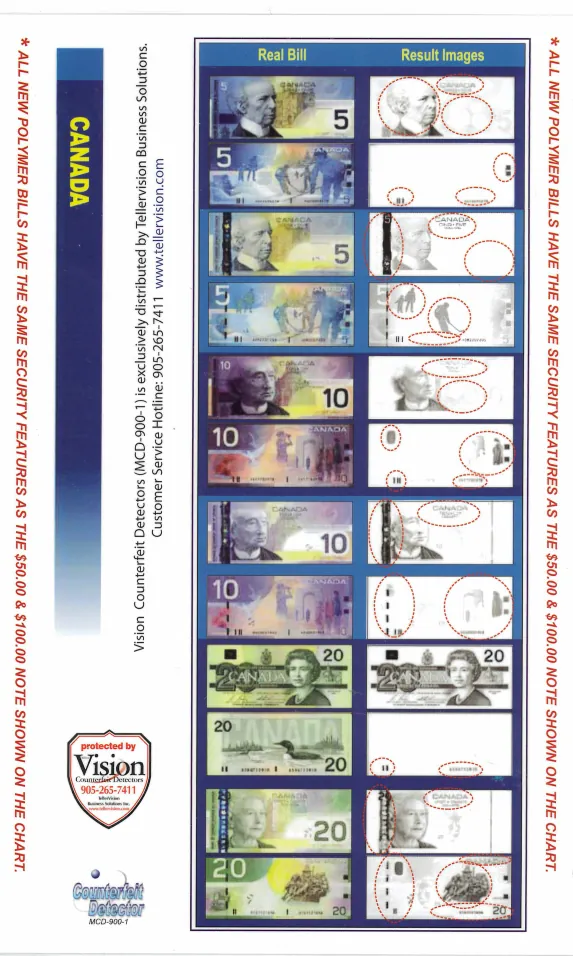
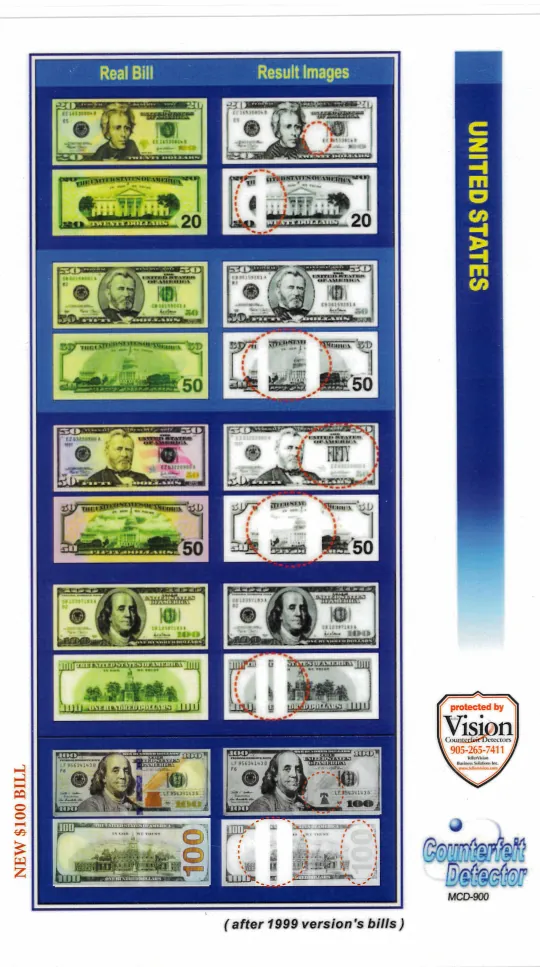
Every machine ships with these reference charts. On the left is the note as anyone sees it. On the right is what appears on the screen. A genuine note shows the pattern, a counterfeit does not.
Canada, $50 and $100Real note beside the result imageCanada, $5 to $20Real note beside the result imageUnited StatesIncluding the redesigned $100
Who uses it
The chains, banks and casinos that did their own due diligence.
Several standardized on the Vision detector across every location. Police forces have used it to verify seized bills.
Dollarama
Home Depot
Canadian Tire
Tim Hortons
McDonald’s
BMO
TD Bank
CIBC Intria
Casino Niagara
No Frills
Foot Locker
Giant Tiger
T&T Supermarket
Mandarin Restaurants
Toronto Parking Authority
Ukrainian Credit Union
Radisson Aruba Casino
Buck or Two
Playground
Mendocino
Dragonfly
Logos are the property of their respective owners and are shown to identify organizations that have used Vision counterfeit detectors. Articles from 2004 and 2008 also name the Royal Bank of Canada, Scotiabank, Loblaws, Cineplex Odeon Theatres, Hilton Hotels, Country Style, York Regional Police and the Ontario Provincial Police.
★ Special promotion
We deliver it, set it up, and train your staff — at no additional charge.
See the Vision detector working in your own store before you commit. For a limited time, the whole program is on us.
If you are responsible for standardizing detection across a region or a chain, this is the least expensive way to find out whether it works in your environment.
Call 905-265-7411 and tell us how many locations you are considering.
Buying options
Two ways in, depending on how many counters you have.
The equipment is the same. What changes is how it gets deployed and how your people get trained.
Multi site
Loss prevention programs
For chains standardizing on one detector across every store, and for the loss prevention team that has to make it stick.
Equipment is half of it. The other half is the person holding the bill.
There’s almost nothing to learn — the result shows the moment a note slides in. Here’s what backs your staff up.
In-person training (Toronto area)
We come to your counter and run the session with your own staff.
Reference pamphlets in every box
See exactly what a genuine note and a fake look like under the lens.
Usage guidance
What to do with the machine day to day, written for cashiers rather than for engineers.
Best practices
What to do when a bill fails, and how to handle it without escalating things at the till.
See it in action
Our Instagram shows the detector working day to day, with more how-to videos on the way.
Ongoing support
A number that is answered around the clock, by people who know the equipment.
Track record
Twenty five years of other people vouching for it.
Quoted as published, with the paper and date on each one.
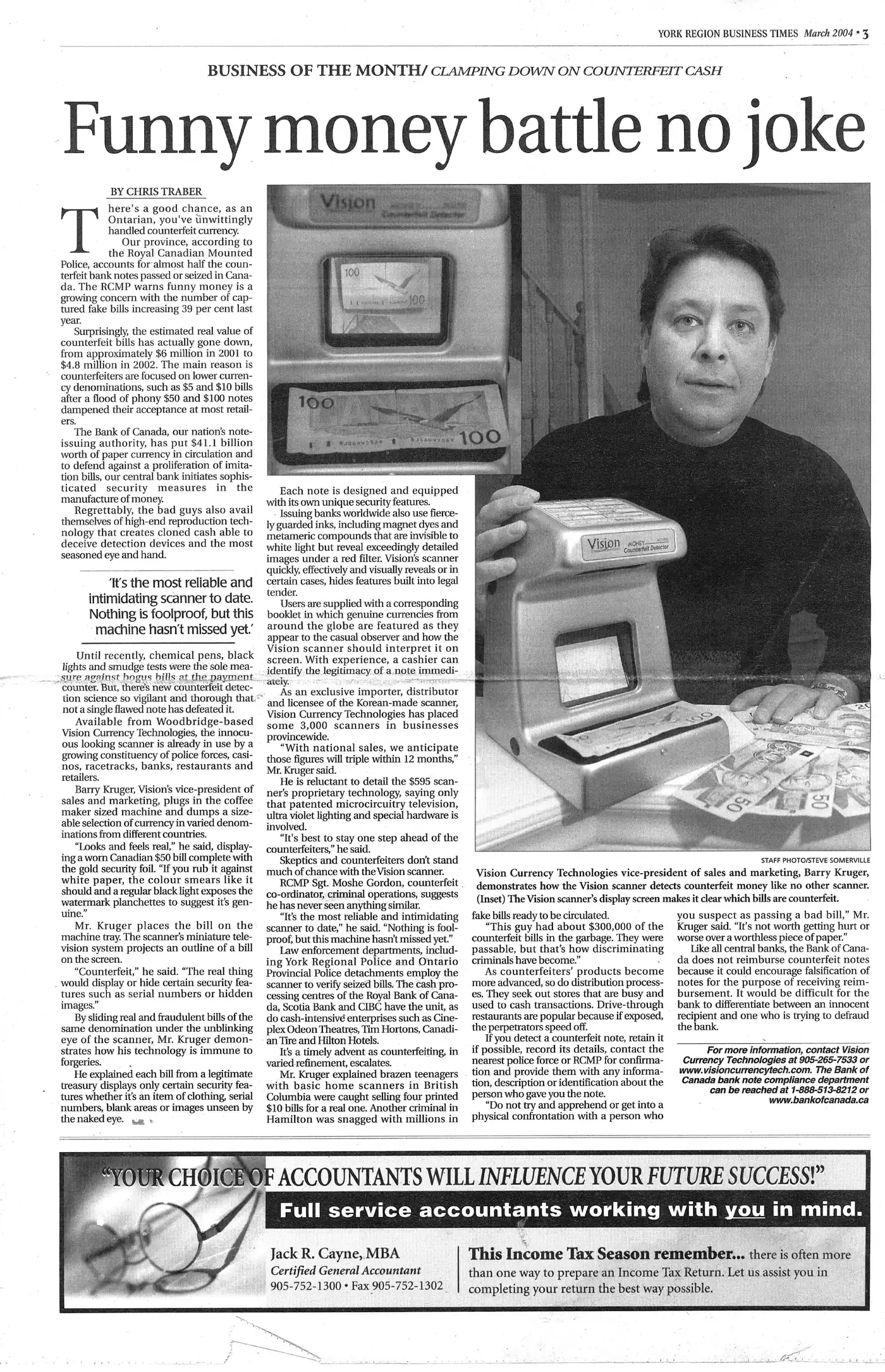
It’s the most reliable and intimidating scanner to date. Nothing is foolproof, but this machine hasn’t missed yet.
Sgt. Moshe GordonRCMP counterfeit co-ordinator, criminal operations York Region Business Times, March 2004
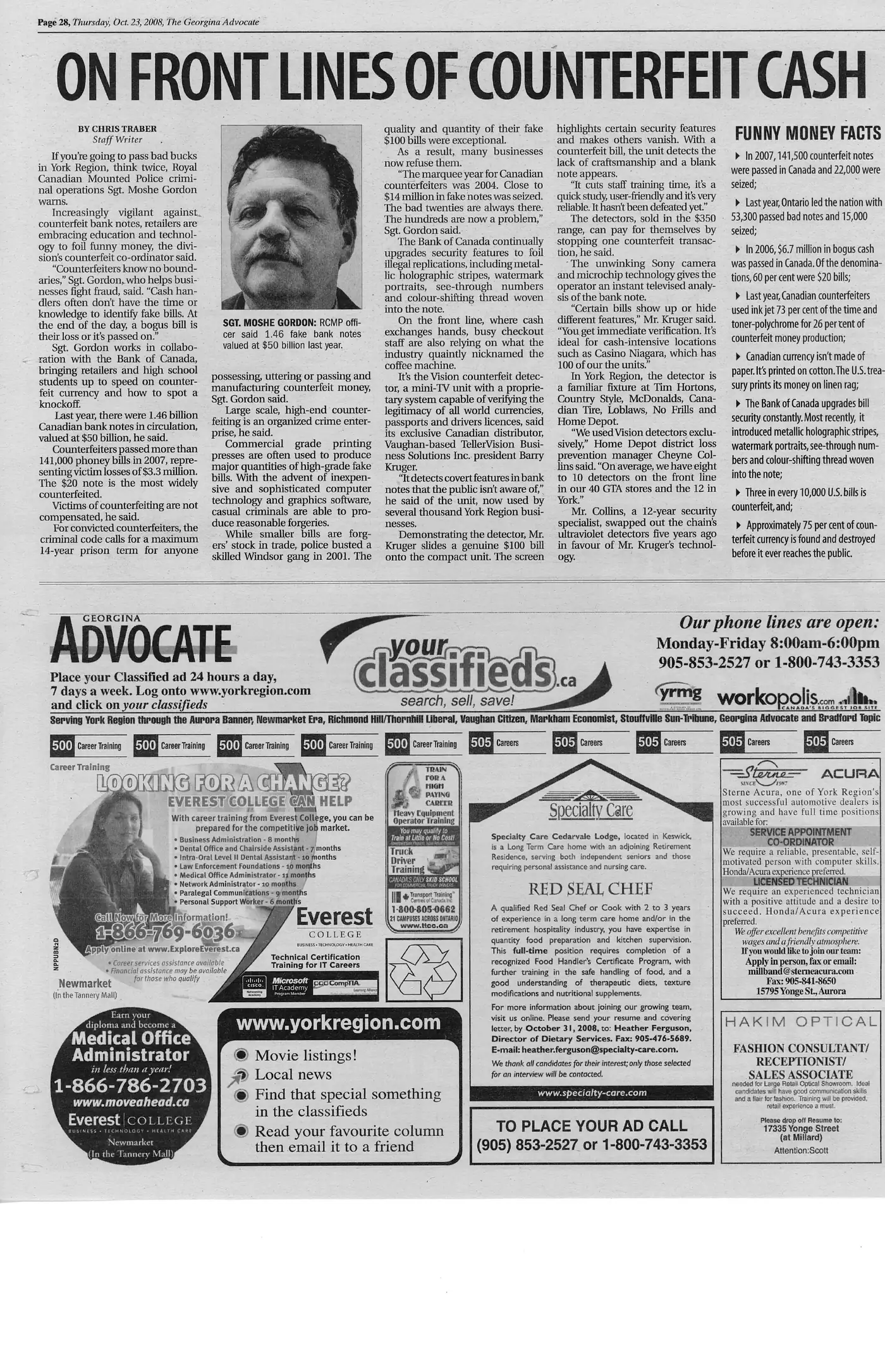
We used Vision detectors exclusively. On average, we have eight to 10 detectors on the front line in our 40 GTA stores and the 12 in York.
Cheyne CollinsDistrict loss prevention manager, Home Depot — a 12-year security specialist who swapped the chain’s ultraviolet detectors for the Vision technology The Georgina Advocate, October 2008
Press and television
The coverage, set as text you can actually read.
Each article is reproduced here as real text. You can also open the original page and jump straight to the part about Barry, with a magnifier for the fine print.
York Region Business Times
Funny money battle no joke
By Chris Traber · March 2004
The article that produced the quote Tellervision has been known by ever since.
The Georgina Advocate
On front lines of counterfeit cash
By Chris Traber, Staff Writer · Thursday, October 23, 2008
Five years after Home Depot swapped out its ultraviolet detectors, its loss prevention manager explains why.
Toronto Star
The secret war against 'funny money'
By Rachel Ross · Monday, September 1, 2003
A technology columnist sets out to debunk the machine, then calls the RCMP about it.
On television
Trusted protection you can see
Every machine comes with the decal.
When customers see it in a supermarket, a restaurant or a shop, it means that business is actively checking the cash it takes.
A visible signal to anyone thinking of passing a fake note
Reassurance for customers that the till is being checked
Carries the 24 hour hotline, so staff always know who to call
Get in touch
Send us a message.
Tell us roughly how many counters you have and we will get back to you the same business day. Prefer to talk it through? The numbers are on the right, and the support line is answered around the clock.
Available from Woodbridge-based Vision Currency Technologies, the innocuous looking scanner is already in use by a growing constituency of police forces, casinos, racetracks, banks, restaurants and retailers.
Barry Kruger, Vision's vice-president of sales and marketing, plugs in the coffee maker sized machine and dumps a sizeable selection of currency in varied denominations from different countries.
"Looks and feels real," he said, displaying a worn Canadian $50 bill complete with the gold security foil. "If you rub it against white paper, the colour smears like it should and a regular black light exposes the watermark planchettes to suggest it's genuine."
Mr. Kruger places the bill on the machine tray. The scanner's miniature television system projects an outline of a bill on the screen.
"Counterfeit," he said. "The real thing would display or hide certain security features such as serial numbers or hidden images."
By sliding real and fraudulent bills of the same denomination under the unblinking eye of the scanner, Mr. Kruger demonstrates how his technology is immune to forgeries.
As an exclusive importer, distributor and licensee of the Korean-made scanner, Vision Currency Technologies has placed some 3,000 scanners in businesses provincewide.
Skeptics and counterfeiters don't stand much of a chance with the Vision scanner. RCMP Sgt. Moshe Gordon, counterfeit co-ordinator, criminal operations, suggests he has never seen anything similar.
"It's the most reliable and intimidating scanner to date," he said. "Nothing is foolproof, but this machine hasn't missed yet."
Law enforcement departments, including York Regional Police and Ontario Provincial Police detachments employ the scanner to verify seized bills. The cash processing centres of the Royal Bank of Canada, Scotia Bank and CIBC have the unit, as do cash-intensive enterprises such as Cineplex Odeon Theatres, Tim Hortons, Canadian Tire and Hilton Hotels.
It's the Vision counterfeit detector, a mini-TV unit with a proprietary system capable of verifying the legitimacy of all world currencies, passports and drivers licences, said its exclusive Canadian distributor, Vaughan-based TellerVision Business Solutions Inc. president Barry Kruger.
"It detects covert features in bank notes that the public isn't aware of," he said of the unit, now used by several thousand York Region businesses.
Demonstrating the detector, Mr. Kruger slides a genuine $100 bill onto the compact unit. The screen highlights certain security features and makes others vanish. With a counterfeit bill, the unit detects the lack of craftsmanship and a blank note appears.
"It cuts staff training time, it's a quick study, user-friendly and it's very reliable. It hasn't been defeated yet."
The detectors, sold in the $350 range, can pay for themselves by stopping one counterfeit transaction, he said.
"Certain bills show up or hide different features," Mr. Kruger said. "You get immediate verification. It's ideal for cash-intensive locations such as Casino Niagara, which has 100 of our units."
In York Region, the detector is a familiar fixture at Tim Hortons, Country Style, McDonalds, Canadian Tire, Loblaws, No Frills and Home Depot.
"We used Vision detectors exclusively," Home Depot district loss prevention manager Cheyne Collins said. "On average, we have eight to 10 detectors on the front line in our 40 GTA stores and the 12 in York."
Mr. Collins, a 12-year security specialist, swapped out the chain's ultraviolet detectors five years ago in favour of Mr. Kruger's technology.
Last week I saw an interesting counterfeiting detection system made by Woodbridge-based Vision Currency Technologies. Barry Kruger, the company's vice-president of sales, brought a unit to the Star and scanned bill after bill with the device. Each time he inserted a new bill, an image of it would come up on a screen. But only certain parts of each bill would appear. Sometimes it was the jacket on a men's coat. Sometimes it was a serial number. And sometimes the bill just looked like a big blank rectangle.
Real bills, Kruger explained, have certain characteristics when viewed with his machine. Only certain parts of the ink would appear.
I was skeptical that Kruger's device worked at all. But RCMP Sergeant Moshe Gordon, the counterfeit co-ordinator for Ontario, said that Kruger's device didn't just work, it worked well. In fact, he said it was the best he has ever used.
"There is no device out there that is completely reliable," Gordon said. "However, I haven't found a note yet that has really defeated that machine."
Kruger calls it the coffee maker, because of its resemblance to the small household appliance.
"It's probably the best counterfeit detection device out there, but we don't want people to only rely on a machine," he said. Better to use it in tandem with other techniques as well.























 Built for loss prevention teams